
Plastic recycling is often thought as a matter of separating packages, collection bins and sorting plants. In chemistry, however, the harder question begins much later: once a plastic item has become waste, can its carbon atoms be recovered with enough quality to make new materials again?
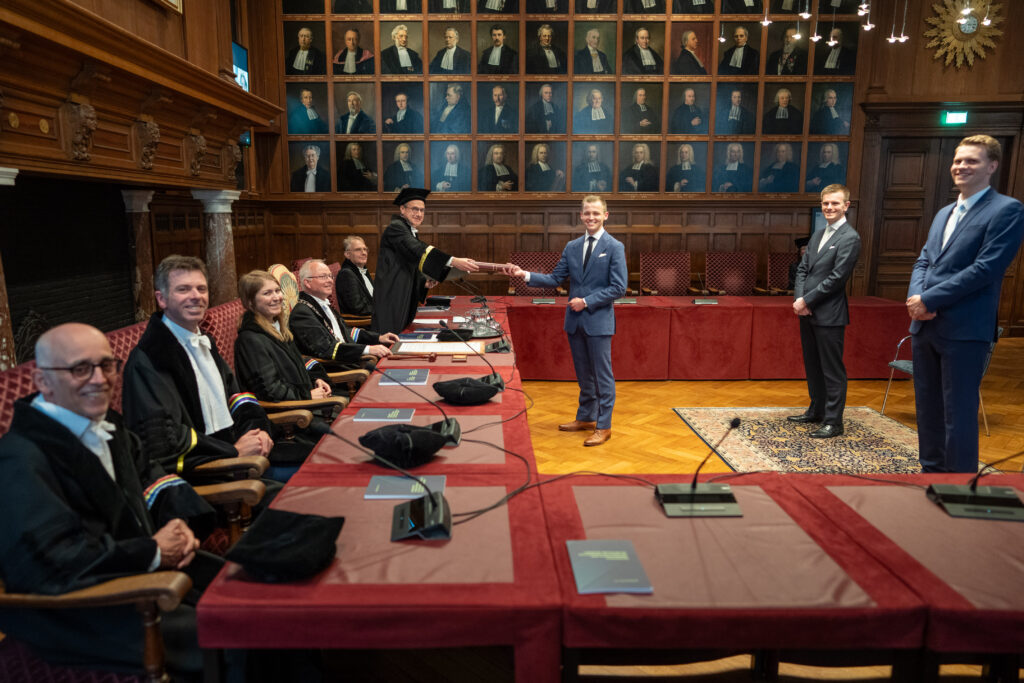
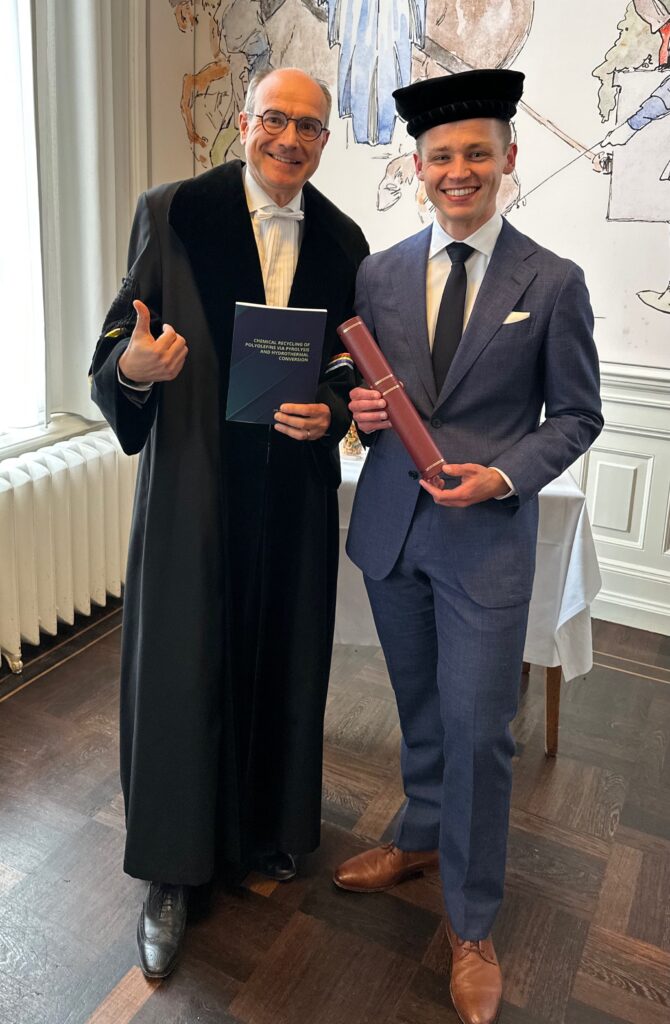
That is the central question explored in the PhD thesis Chemical Recycling of Polyolefins via Pyrolysis and Hydrothermal Conversion by Jochem van de Minkelis, who successfully defended his research and became a doctor at Utrecht University on 6 May, 2026. His work, supervised prof. Weckhuysen and dr. Vollmer, focuses on polyolefins, especially polyethylene, one of the most widely used families of plastics. These materials are found in packaging, films, bottles, containers and household goods, yet their chemical strength makes them difficult to recycle into high-quality products. The thesis studies two routes to break these polymer chains into useful hydrocarbon mixtures: pyrolysis, which uses heat in the absence of oxygen, and hydrothermal conversion, which uses water at very high temperature and pressure.
A world weighed down by plastic
The research is set against a pressing societal problem. Plastics are cheap, light and durable, but the same qualities that made them indispensable have also made them persistent waste. The thesis notes that more than 9.2 billion tonnes of plastic have been produced since the 1950s, while more than 400 million tonnes are now produced annually. Polyethylene and polypropylene together account for more than half of global plastic production.
Most plastic waste is still incinerated, landfilled or lost to the environment. This not only causes pollution and greenhouse gas emissions, but also wastes carbon atoms that originally came from fossil resources. Mechanical recycling remains essential, but it struggles with mixed plastics, multilayer packaging, additives and the gradual loss of material quality after repeated processing. Chemical recycling therefore offers a complementary route: rather than simply melting plastic into a lower-grade product, it aims to return waste plastic to the chemical value chain.
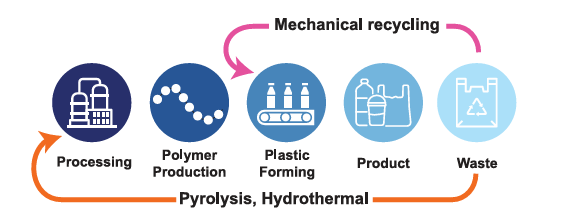
Diagram showing the catalytic recycling pathway for polyolefins. Source: Jochem van de Minkelis, Chemical Recycling of Polyolefins via Pyrolysis and Hydrothermal Conversion, PhD thesis, Utrecht University, 2026.
Opening the plastic chain
One of the thesis’ most relevant findings lies in the world of catalysts. In catalytic pyrolysis, the plastic must reach the active sites of the catalyst. That sounds simple, but many traditional catalysts have pores that are too small for bulky polymer chains. Van de Minkelis shows that mesoporous catalysts, with larger pores, can partly overcome this problem. By using sulphated zirconia on SBA-15, the research demonstrates that smaller polyethylene chains can enter the catalyst pores, allowing a clearer study of how the active sites work. Traditional zeolite Y catalysts, by contrast, are more restricted by mass transfer limitations.
The thesis also refines the understanding of hydrothermal conversion. In this process, water is heated beyond its critical point, where it behaves less like ordinary water and more like a medium able to interact with hydrocarbons. The work shows that, for polyethylene, temperatures of 425–450 °C and reaction times of 0.5–2 hours are needed to reach full conversion with high selectivity towards liquid hydrocarbons. A particularly important insight is that water is not merely a solvent or medium: experiments with deuterated water showed that atoms from water are incorporated into the hydrocarbon products. In other words, water actively participates in the chemistry.
A further innovation is the search for catalysts that can steer hydrothermal conversion towards more valuable products. Cerium oxide emerges as a promising material for producing a naphtha-like stream, with full conversion, high liquid yield, strong alkane/alkene selectivity and good hydrothermal stability. For the production of aromatics, amorphous aluminosilicates perform particularly well, outperforming crystalline zeolites in liquid yield, aromatic selectivity and stability.
The gap between lab and landfill
The thesis is careful not to present chemical recycling as a finished solution. The main limitation is that the chemistry still has to move from controlled laboratory systems towards the messy reality of plastic waste. Real waste contains mixtures of polymers, pigments, fillers, food residues and metals, all of which can affect catalysts and reactor materials.
There is also a fundamental materials challenge. The larger-pore catalysts improved access for lower molecular weight polyethylene, but realistic polymers with higher molecular weights remained difficult to bring into the catalyst pores.
Hydrothermal conversion brings its own barriers. It requires high temperatures and pressures, and supercritical water can be corrosive. Several catalysts also lose structural integrity under these conditions, even when some activity remains after reuse. The work therefore advances the chemistry, but it does not yet solve the engineering and economic questions needed for large-scale application.
From disposable carbon to circular materials
The next step is to design catalysts that are not only active in model experiments, but robust enough for realistic plastic streams. That means larger and more accessible pore structures, better resistance to hydrothermal conditions, improved regeneration after use and a deeper understanding of why certain materials remain active even after structural changes.
Future research will also need to test mixed and contaminated waste streams, integrate the chemical products into existing refinery infrastructure, and compare the environmental and economic performance of pyrolysis and hydrothermal conversion against other recycling routes. The promise of the thesis is not that it offers one simple answer to plastic waste, but that it clarifies what chemistry must still learn before difficult plastics can become circular materials rather than disposable carbon.
Please note that this blog post is written for a general audience with an interest in science, and therefore does not cover the full technical depth of the doctoral thesis. The complete thesis can be found here: Chemical Recycling of Polyolefins via Pyrolysis and Hydrothermal Conversion – Fingerprint – Utrecht University