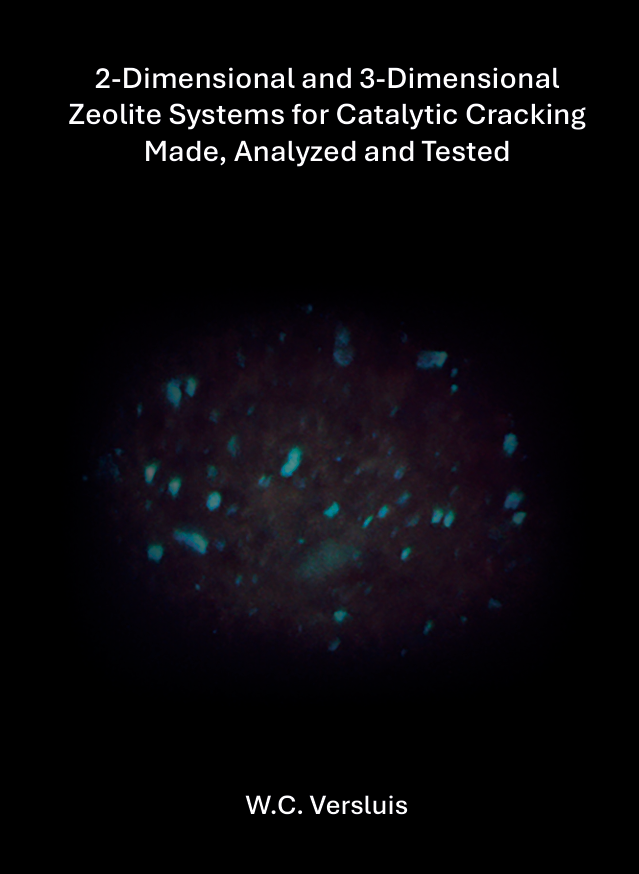
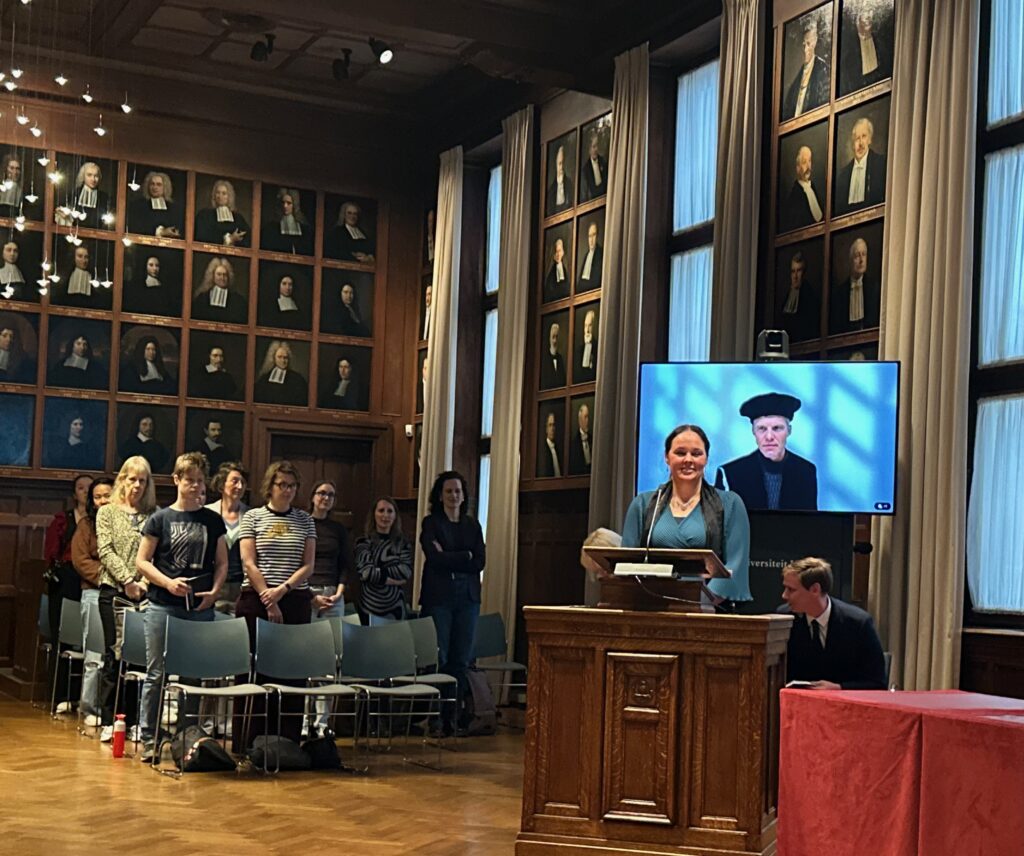
Caroline Versluis successfully defended her PhD thesis at Utrecht University and became a doctor on April 20, 2026. Her research, supervised by Professor Bert Weckhuysen and Professor Eelco Vogt, advances on the characterisation of industrial Fluid Catalytic Cracking (FCC) catalysts by linking coke formation, local particle composition and zeolite–binder interactions in both conventional 3-dimensional catalyst particles and in newly developed 2-dimensional (2D) FCC model materials. At the heart of the thesis lies an issue of growing industrial urgency: the role of catalysts in turning increasingly complex raw materials into useful chemical products.
The broader relevance of Versluis’ research lies in the changing demands placed on industrial catalysis. As the chemical industry moves towards more circular and lower-carbon processes, catalysts will need to handle feedstocks that are far more complex than conventional fossil resources, including plastic waste and biomass-derived materials. These raw materials are often difficult to convert selectively and efficiently, partly because of their large molecular structures and diverse chemical compositions. By examining how FCC catalyst particles perform, accumulate carbon-rich deposits, and ultimately deactivate, this doctoral work provides fundamental insights that are crucial to improve catalytic processes for a more sustainable production of chemicals.
The main innovation of the thesis is the development of two-dimensional FCC model materials. Conventional FCC catalyst particles are small, complex, and 3-dimensional, which makes it difficult to see what is happening inside them. Versluis developed flat 2D materials made from controlled combinations of zeolite, clay, and binder components. These model systems make it easier to study important features of FCC catalysts, especially the interaction between zeolite and binder, which is difficult to investigate in real industrial catalyst particles.
Her work also shows that these 2D materials can be used as model catalysts for plastic pyrolysis. In these experiments, the presence of zeolite promoted the formation of larger aromatic products at lower temperatures. This suggests that the new model materials can help researchers better understand how catalyst structure influences reactions relevant to plastic waste conversion.
A key limitation identified in the thesis is that conventional analytical techniques cannot always reveal the full complexity of FCC catalyst particles. Methods such as confocal fluorescence microscopy can identify zeolite and clay domains, but their resolution and depth are limited by light scattering, especially when silica is present. This means that important details inside the particle can remain hidden. The new 2D materials help overcome part of this problem, but they are still model systems.
In Versluis’ thesis, the newly appointed doctor raises an important question: how far can insights from well-defined 2D model materials be translated into improved 3-dimensional catalyst particles for industrial use? Their flat structure makes them easier to study, but it does not fully reproduce the complexity of real industrial FCC particles. Therefore, the results provide valuable fundamental insight, but further work is needed to translate these findings directly to industrial catalyst design and large-scale processing.
Please note that this blog post is written for a general audience with an interest in science, and therefore does not cover the full technical depth of the doctoral thesis. The complete thesis can be found here: 2-Dimensional and 3-Dimensional Zeolite Systems for Catalytic Cracking Made, Analyzed and Tested – Utrecht University