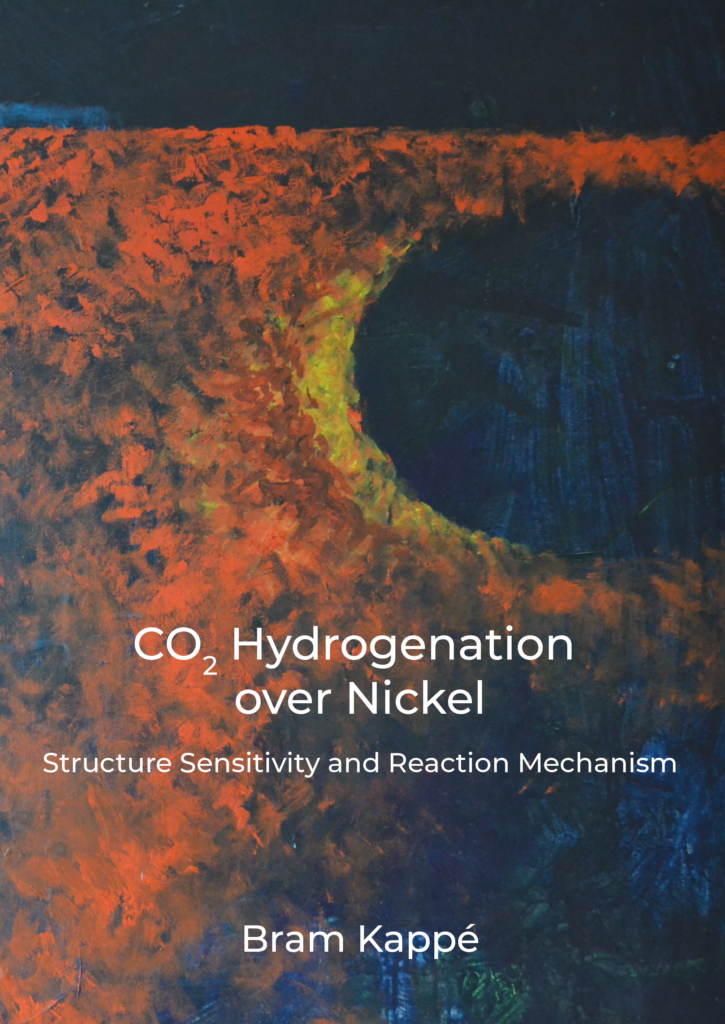
Congratulations to Dr. Bram Kappé on a successful PhD defense, during which he defended his PhD thesis, supervised by Prof. Bert Weckhuysen and Dr. Matteo Monai.
In his PhD thesis, Bram tackled fundamental questions in CO₂ hydrogenation to methane, an attractive route for converting atmospheric or industrial CO₂ into fuel or chemical building blocks. His work specifically addressed the structure sensitivity of the reaction and the mechanisms by which it proceeds on catalyst surfaces.
Bram began with an extensive literature review examining reaction mechanisms from a spectroscopic perspective, developing frameworks to distinguish active reaction intermediates from inactive spectator species. He then explored synthetic methods to create well-defined catalyst sets for studying structure sensitivity, employing solution-based colloidal synthesis to grow nickel nanoparticles that were deposited on five different support materials. Interestingly, after reduction treatment, particle growth varied dramatically depending on the support, with severe growth on some materials while particles remained small on silica.
Using an innovative approach with probe molecules including formic acid, methanol, and CO₂, Bram investigated the structure sensitivity of individual reaction steps rather than the overall reaction. By entering the reaction network at various positions, he observed how different surface species formed and converted. His results revealed that catalysts with larger nickel nanoparticles performed several reaction steps faster, providing clear evidence of structure-sensitive behavior.
Finally, Bram detailed the structure insensitivity of N₂ adsorption on nickel surfaces and examined how hydrogen co-adsorption influences the infrared signature of N₂ adsorption, contributing valuable insights into surface characterization methods.
His work advances fundamental understanding of CO₂ hydrogenation mechanisms and structure-activity relationships, providing important knowledge for designing improved catalysts for sustainable fuel production.
Bram’s full thesis can be read here.