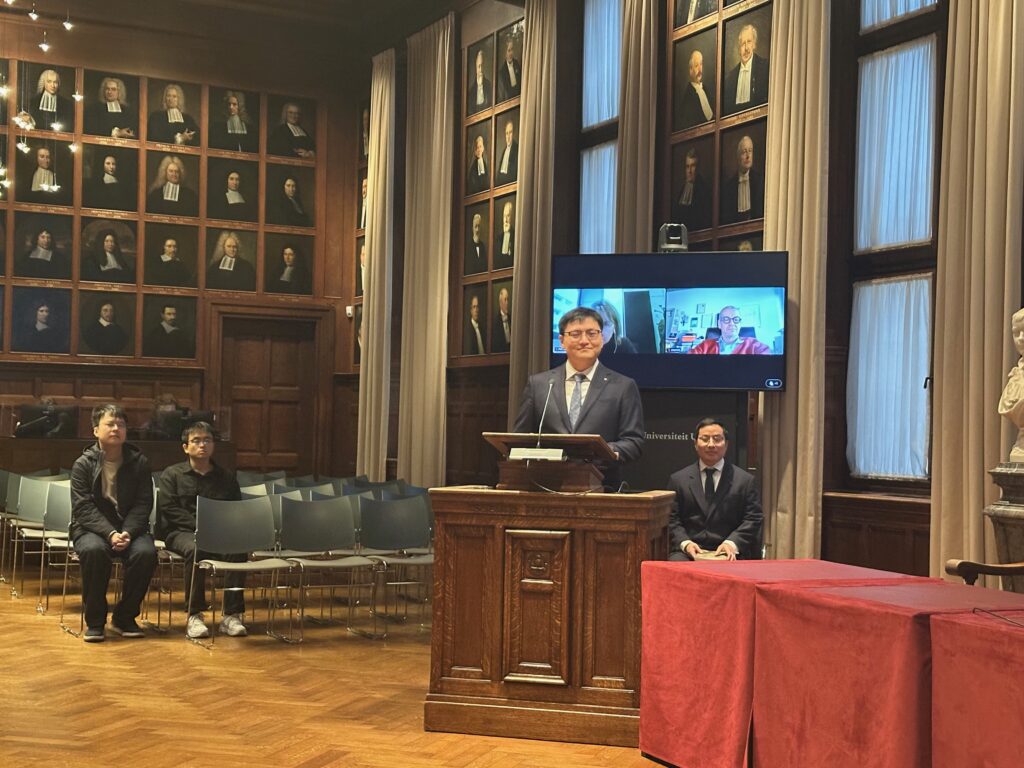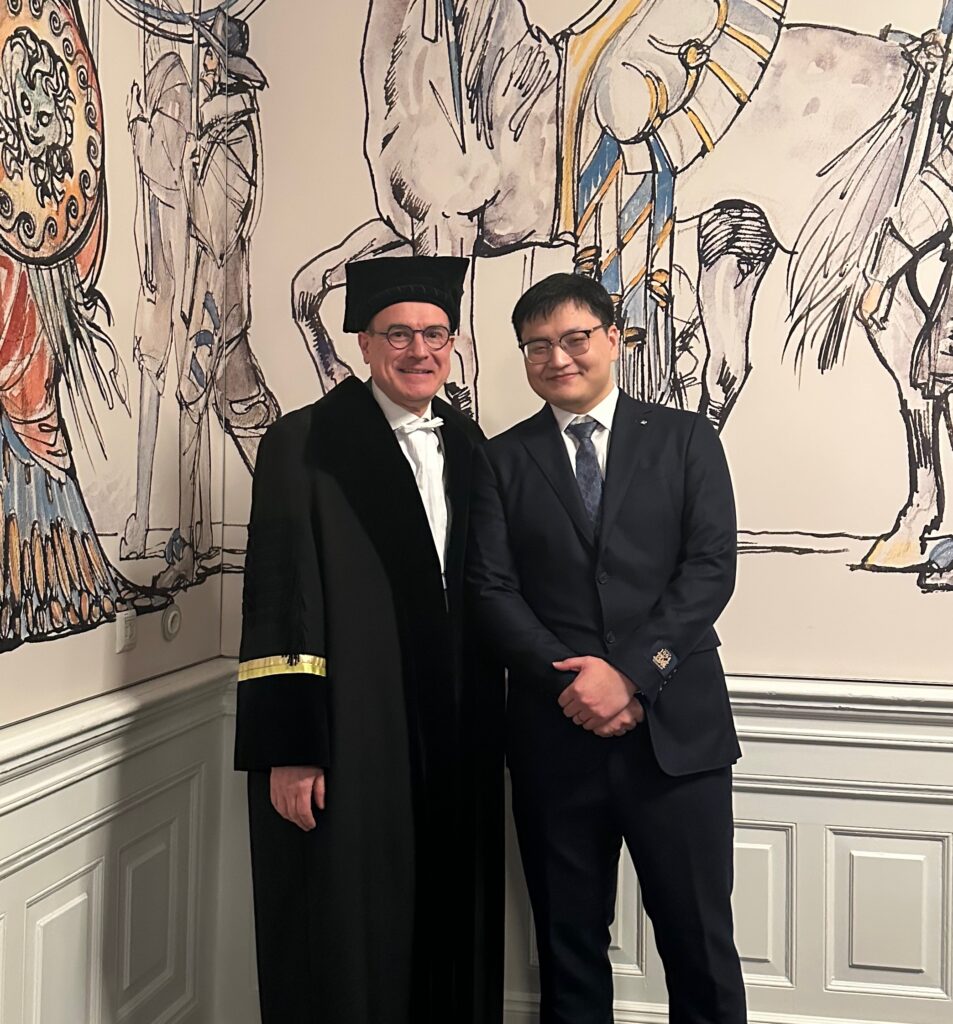
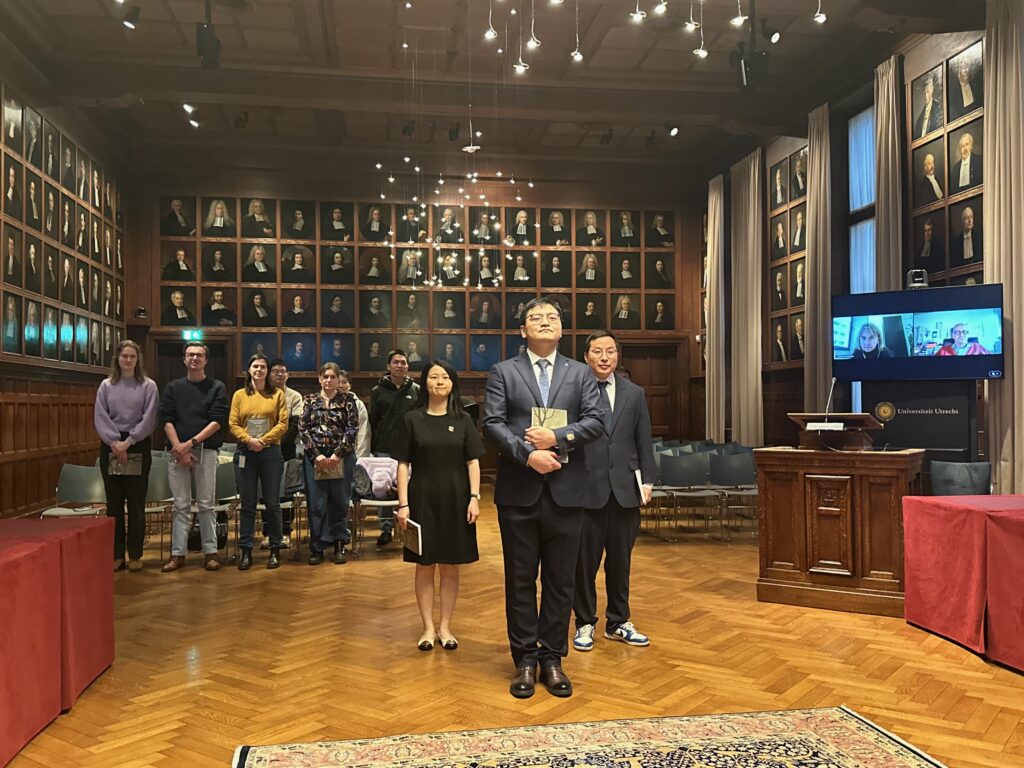
Congratulations to Dr. Xiang Yu on a successful PhD defense, during which he defended his PhD thesis, supervised by Prof. Bert Weckhuysen and Dr. Matteo Monai.
In his PhD thesis, Xiang addressed some of the most pressing open questions in heterogeneous catalysis: how do atomically dispersed metal active sites behave dynamically under real reaction conditions, and how do their structural heterogeneities govern catalytic performance? To tackle these questions, he combined rational catalyst design with time-resolved operando spectroscopy and density functional theory (DFT) calculations.
A central contribution of Xiang’s work was the development of a novel penta-coordinate Al³⁺ enriched alumina support (Al₂O₃-x) via a one-pot synthesis strategy. This amorphous material features an unusually high fraction of pentacoordinated Al sites and a large specific surface area, enabling stable atomic dispersion of metal species and suppressing sintering — a common problem with conventional reducible supports. Al₂O₃-x served as a model support throughout the thesis, offering a well-defined platform for mechanistic studies.
Using methane oxidation over Pd-based catalysts as a model reaction, Xiang systematically disentangled the roles of Pd nanoparticles, clusters, and single atoms. Second-resolved operando quick X-ray absorption spectroscopy under alternating reaction atmospheres revealed that Pd clusters are intrinsically more reactive than Pd nanoparticles, while operando FT-IR spectroscopy and DFT calculations identified distinct deactivation pathways for each active-site type: carbonate poisoning for PdO nanoparticles and slow water desorption for single-atom Pd.
In the final part of his thesis, Xiang demonstrated that even within a class of seemingly uniform atomically dispersed sites, substantial heterogeneity exists. Studying CO₂ hydrogenation over atomically dispersed Zn on Al₂O₃-x, he identified a “site density effect,” whereby increasing the density of Zn single atoms promotes cooperative interactions between neighboring sites, lowering the barrier for formate hydrogenation and improving both activity and methanol selectivity.
Xiang’s full thesis can be read here.